Wednesday, October 30, 2013

Sunday, April 07, 2013
Monday, May 14, 2012

Wednesday, April 25, 2012
London 2012 - Video Game
Back in 2010 I was selected to be the female diver for the London 2012 Olympics video game. The game was developed by Sega Studios Australia, so I went to their studio at the Gold Coast to do some filming in a snazzy Velcro suit with lots of joint markers linked to software. I have a few photos and videos from the fun day of shooting.


The game will be released world wide on the 26th of June. The game is compatible with Playstation 3, X-box 360 and PC.
http://en.wikipedia.org/wiki/London_2012_(video_game)


Wednesday, April 11, 2012
Diving Article from the 2008 Olympics - Drop Cam
http://online.wsj.com/article/SB121856740339434067.html
BEIJING -- High-tech televisual bells and whistles have carried couch-based Olympic watching way beyond the mere reality of being here. Thousands of cameras are catching the action in China -- every one of them high-definition. Yet for a feat of engineering magic that dazzles as it baffles, nothing beats the DiveCam.
 On TV, a diver walks out onto a platform. The camera fixes on him. He waits. He leaps. And then -- somehow -- the camera stays with him as he plunges. In the instant it takes him to break the water's surface, the picture suddenly cuts to an underwater shot -- and we watch in disbelief as the dive culminates in a burst of bubbles.
How do they do it?
Well, there's a rope. There's a pulley. And the rope and the pulley work a contraption made out of a pipe. The whole gizmo is based on the brilliant insight that objects fall at the same rate regardless of mass. A Tuscan by the name of Galileo came up with it about 400 years ago; if he were alive, he'd call it cutting edge. And there's the beauty of it: It's sophisticated, yes, but only because it's simple.
Why keep this a secret? They put the camera into the pipe. When the diver dives, they drop the camera.
"Ideally," Rob Brear said the other day, "the diver and the camera drop at the same time." Mr. Brear, who is the DiveCam's chief dropper, was in Beijing's colossal "Water Cube," the National Aquatic Center, standing behind a plastic screen on a ledge built just below the diving tower's 10-meter platform. Between him and the platform, the DiveCam's pipe hung suspended by a chain from the roof.
 AFP/Getty ImagesMr. Brear, a 54-year-old Australian, was warming up -- with the divers -- for the first platform events of the Games on Monday and Tuesday. "After the camera drops," he went on, "what you do is you pull it up again." Ken East, another Australian and Mr. Brear's teammate, sat behind him on a stool with his hand on the pulley's brake. "It's called gravity," he said.
Two Australian divers appeared on the platform for practice and noticed Mr. Brear and Mr. East on the ledge beneath them. "How do you get in there?" Briony Cole asked. Mr. Brear replied, "You just climb." Melissa Wu said, "That's scary!"
She and Ms. Cole then executed synchronized triple somersaults as Mr. Brear let go of his rope and dropped the DiveCam.
The idea for this wizardry came to David Neal, now NBC's Olympic production supervisor, in what he recalls as an Isaac Newton moment. It was in the lobby bar of the Ritz-Carlton 13 years ago in Atlanta ahead of that city's Olympics. He and an associate had been to the diving venue where they had climbed the 10-meter platform.
 Getty Images"When you stand up there," he says, "it makes you marvel at what these athletes will do. We were thinking: What must it be like to plummet from that height? How can we capture the sensation?"
At which point the apple landed on Mr. Neal's head: "Why not let gravity do the work?" On the requisite cocktail napkin, and in keeping with Sir Isaac's universal laws, he sketched a cartoonish doohickey. Then came his true inspiration: Mr. Neal hired a dean of cinematic ingenuity to make it work.
Garrett Brown revolutionized the movie business 38 years ago when he invented the Steadicam, a mechanical arm for cameramen that smooths away the jerkiness of hand-held shots. Much later, he came up with the Skycam, which rides a web of wires above the heads of football players. In between, Mr. Brown, 66 years old, got his one-line brief from NBC: "They wanted a camera," he says, "that stayed with divers, including going underwater with them."
He calls it "one of those lovely problems that keep you up at 4 a.m., building things in your mind." The DiveCam couldn't be big or noisy. And it had to be close enough to the diver to "make you feel like you were in a race car, looking sideways, heading into the water."
The obvious answer: a camera in a tube. "Here's the tube," Mr. Brown said before the Olympics in the workshop at his country house in Pennsylvania. He cleared a space among the nuts and bolts on a benchtop to make room for a sample of custom-extruded aluminum piping. "The DiveCam has 53 feet of this," he said.
The falling camera rides a rail on the inside of the pipe. A glass strip runs along the pipe's full length; the camera takes its picture through the glass. From the diving platform to the water line, the glass is smoky. Below the line, it's clear, so the camera need not adjust its exposure as it streaks into underwater darkness.
The pipe is caulked. The camera drops through air. "It doesn't splash into the water," Mr. Brown said. "That would look horrible."
A camera in free fall raises an issue: How do you stop it? Newton didn't have a bungee cord, but Mr. Brown did. One hooked to the pool's roof stopped the camera just before it hit bottom. A one-way pulley locked when the camera reached the end of its rope, just above the pool bottom, and kept it from recoiling.
Once that problem was solved, Mr. Brown ironed out a kink to keep the camera's electric cable from snapping, and devised an extra tilt-and-pan control, monitored by a cameraman, to make doubly sure that divers stay within the picture's frame. Mr. Brown calls his completed DiveCam a "pure idea," except for one thing: Objects all may fall at the same rate, but all divers actually don't.
Dives in the straight-legged pike position take longer, for instance, because the upkick of the legs momentarily holds the body suspended. And not all divers fall through the same space: Some fall closer to the platform; some thrust themselves farther out. "It means you can't just drop the camera," Mr. Brown says. "Somebody has to operate it."
In China, that somebody is Mr. Brear. He started out as a toolmaker and has spent 34 years as a technician for the Seven Network in Australia. As newer and newer technologies pile on, Mr. Brear has been shepherding his Newtonian camera to diving events around the world since 2000. Now he is on loan to the organization feeding the world the bulk of its pooled Olympic pictures -- Beijing Olympic Broadcasting, BOB for short.
Mr. Brear refined Mr. Brown's bungees and pulleys down to a wheel-filled box screwed to the inside wall of his ledge. His only other gear is a pair of rubber garden gloves to help grip the black nautical rope that runs to the DiveCam. He was gripping it hard as Matthew Mitcham, another Australian, appeared on the platform.
"Running dives are easy -- you nail most of them," said Mr. Brear, eyes fixed on his monitor. "Handstands are hardest. Divers go up a bit first. You have to take the rope up, then let go. Some people pick this up straight away, others can't do it at all."
The diver stood on the platform's edge -- when his hips twitched, Mr. Brear tensed -- and then launched himself into a forward flying somersault. With a flourish, Mr. Brear released his rope. The camera fell with a whoosh and jolted to a stop with a shudder that shook the diving tower.
From top to bottom, the diver stayed inside the DiveCam monitor's frame. "Nailed it," said Mr. Brear.
BEIJING -- High-tech televisual bells and whistles have carried couch-based Olympic watching way beyond the mere reality of being here. Thousands of cameras are catching the action in China -- every one of them high-definition. Yet for a feat of engineering magic that dazzles as it baffles, nothing beats the DiveCam.
How do they do it?
Well, there's a rope. There's a pulley. And the rope and the pulley work a contraption made out of a pipe. The whole gizmo is based on the brilliant insight that objects fall at the same rate regardless of mass. A Tuscan by the name of Galileo came up with it about 400 years ago; if he were alive, he'd call it cutting edge. And there's the beauty of it: It's sophisticated, yes, but only because it's simple.
Why keep this a secret? They put the camera into the pipe. When the diver dives, they drop the camera.
"Ideally," Rob Brear said the other day, "the diver and the camera drop at the same time." Mr. Brear, who is the DiveCam's chief dropper, was in Beijing's colossal "Water Cube," the National Aquatic Center, standing behind a plastic screen on a ledge built just below the diving tower's 10-meter platform. Between him and the platform, the DiveCam's pipe hung suspended by a chain from the roof.
AFP/Getty ImagesSilver medalists from Australia Melissa Wu and Briony Cole (foreground).
Two Australian divers appeared on the platform for practice and noticed Mr. Brear and Mr. East on the ledge beneath them. "How do you get in there?" Briony Cole asked. Mr. Brear replied, "You just climb." Melissa Wu said, "That's scary!"
She and Ms. Cole then executed synchronized triple somersaults as Mr. Brear let go of his rope and dropped the DiveCam.
The idea for this wizardry came to David Neal, now NBC's Olympic production supervisor, in what he recalls as an Isaac Newton moment. It was in the lobby bar of the Ritz-Carlton 13 years ago in Atlanta ahead of that city's Olympics. He and an associate had been to the diving venue where they had climbed the 10-meter platform.
Getty ImagesHands on, hand off: The secret to operating the DiveCam is knowing when to let go of the rope.
At which point the apple landed on Mr. Neal's head: "Why not let gravity do the work?" On the requisite cocktail napkin, and in keeping with Sir Isaac's universal laws, he sketched a cartoonish doohickey. Then came his true inspiration: Mr. Neal hired a dean of cinematic ingenuity to make it work.
Garrett Brown revolutionized the movie business 38 years ago when he invented the Steadicam, a mechanical arm for cameramen that smooths away the jerkiness of hand-held shots. Much later, he came up with the Skycam, which rides a web of wires above the heads of football players. In between, Mr. Brown, 66 years old, got his one-line brief from NBC: "They wanted a camera," he says, "that stayed with divers, including going underwater with them."
He calls it "one of those lovely problems that keep you up at 4 a.m., building things in your mind." The DiveCam couldn't be big or noisy. And it had to be close enough to the diver to "make you feel like you were in a race car, looking sideways, heading into the water."
The obvious answer: a camera in a tube. "Here's the tube," Mr. Brown said before the Olympics in the workshop at his country house in Pennsylvania. He cleared a space among the nuts and bolts on a benchtop to make room for a sample of custom-extruded aluminum piping. "The DiveCam has 53 feet of this," he said.
The falling camera rides a rail on the inside of the pipe. A glass strip runs along the pipe's full length; the camera takes its picture through the glass. From the diving platform to the water line, the glass is smoky. Below the line, it's clear, so the camera need not adjust its exposure as it streaks into underwater darkness.
The pipe is caulked. The camera drops through air. "It doesn't splash into the water," Mr. Brown said. "That would look horrible."
A camera in free fall raises an issue: How do you stop it? Newton didn't have a bungee cord, but Mr. Brown did. One hooked to the pool's roof stopped the camera just before it hit bottom. A one-way pulley locked when the camera reached the end of its rope, just above the pool bottom, and kept it from recoiling.
Once that problem was solved, Mr. Brown ironed out a kink to keep the camera's electric cable from snapping, and devised an extra tilt-and-pan control, monitored by a cameraman, to make doubly sure that divers stay within the picture's frame. Mr. Brown calls his completed DiveCam a "pure idea," except for one thing: Objects all may fall at the same rate, but all divers actually don't.
Dives in the straight-legged pike position take longer, for instance, because the upkick of the legs momentarily holds the body suspended. And not all divers fall through the same space: Some fall closer to the platform; some thrust themselves farther out. "It means you can't just drop the camera," Mr. Brown says. "Somebody has to operate it."
In China, that somebody is Mr. Brear. He started out as a toolmaker and has spent 34 years as a technician for the Seven Network in Australia. As newer and newer technologies pile on, Mr. Brear has been shepherding his Newtonian camera to diving events around the world since 2000. Now he is on loan to the organization feeding the world the bulk of its pooled Olympic pictures -- Beijing Olympic Broadcasting, BOB for short.
Mr. Brear refined Mr. Brown's bungees and pulleys down to a wheel-filled box screwed to the inside wall of his ledge. His only other gear is a pair of rubber garden gloves to help grip the black nautical rope that runs to the DiveCam. He was gripping it hard as Matthew Mitcham, another Australian, appeared on the platform.
"Running dives are easy -- you nail most of them," said Mr. Brear, eyes fixed on his monitor. "Handstands are hardest. Divers go up a bit first. You have to take the rope up, then let go. Some people pick this up straight away, others can't do it at all."
The diver stood on the platform's edge -- when his hips twitched, Mr. Brear tensed -- and then launched himself into a forward flying somersault. With a flourish, Mr. Brear released his rope. The camera fell with a whoosh and jolted to a stop with a shudder that shook the diving tower.
From top to bottom, the diver stayed inside the DiveCam monitor's frame. "Nailed it," said Mr. Brear.
Tuesday, December 20, 2011
Beijing 2008: The Cost of Gold
What price for an Olympic Gold? How much would you pay?
I recently came across an interesting article from The Science of Sport website. The article can be found here:
www.sportsscientists.com/2008/08/beijing-olympic-medal-price.html
It turns out that each bronze medal will set you back a cool Aus $15 million, while gold and silver will cost you about Aus $40 million!
The point is there is a relationship between money invested and medals won. If you want 20 gold medals, then spend Aus $800 million every four years. The graph above was used to project how many medals Australia would win in Sydney - the dashed line in the graph.

Thursday, October 13, 2011
Melbourne Half Marathon
On Sunday the 9th of October I ran my first half marathon (21.1km) as part of the Marathon Festival.
It was a great day for running - cold with a touch of rain at the end. It was a tough run especially the last 5kms.
My final time was 1:32:38
I finished 363rd out of 7514 runners in the half marathon
Females 20 to 39 years - I finished 45th out of 2736

It was a great day for running - cold with a touch of rain at the end. It was a tough run especially the last 5kms.
My final time was 1:32:38
I finished 363rd out of 7514 runners in the half marathon
Females 20 to 39 years - I finished 45th out of 2736

Thursday, October 06, 2011
Deakin University - Alumni Awards
Deakin University recently announced the inaugural winners of the Deakin Alumni of the Year Awards 2011.
I have been announced along with fellow alumni Benjamin Hayward as Young Alumni of the Year Award winners.
My award was in recognition of her exceptional sporting achievements particularly in diving.
 http://www.deakin.edu.au/alumni/profiles/awards/briony-cole.php
There were seven recipients of Alumni of the Year Award winners.
The awards ceremony will be held on the 19th of October.
I have been announced along with fellow alumni Benjamin Hayward as Young Alumni of the Year Award winners.
My award was in recognition of her exceptional sporting achievements particularly in diving.

There were seven recipients of Alumni of the Year Award winners.
The awards ceremony will be held on the 19th of October.
Sunday, September 18, 2011
Pacific Rim - Wellington, New Zealand
On the 17th of August I was off to Wellington, NZ for a week for a diving competition. This time things were different, this time I was going as an official. Well actually I had a few titles - Victorian assistant coach, Victorian team manager and judge. The Victorian team included 14 divers from 11 years to 18 years, also Helen and John Hillard and Tom Michaels as head coach.

It was a great trip - the Victorian divers did a great job coming home with lots of medals.
I learnt a great deal being on dry side of the pool deck and I had an excellent time catch up with lots of old diving friends!


There was the divers showing us how to do a handstand, then it was John, Helen and my turn - I was pretty happy with my handstand!

On the last night we had one of the best farewell functions (and i have been to plenty of those!) There was lots of dancing and laughs!
Thursday, September 01, 2011


Friday, July 08, 2011
Monday, December 20, 2010
Retirement
Well the time has come for me to hang up my bathers.


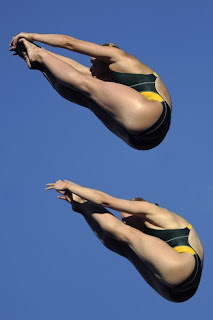





I have had a great diving career, competing and medalling at all diving competitions, including:
- 2008 Olympics - Beijing - Silver Medal
- 2005, 2007, 2009 World Championships - Montreal, Melbourne, Rome - Silver and Bronze Medals
- 2008, 2010 - World Cup - Beijing, Changzhou - Bronze Medal
- 2006, 2010 - Commonwealth Games - Melbourne, Delhi - Gold, Silver and Bronze Medals
- 2007, 2009, 2010 - Diving World Series - Doha, Changzhou, Mexico City, Sheffield, Nanjing - Silver and Bronze Medals
- 2001, 2005 - World University Games - Beijing, Izmir - Bronze Medal
- Countless Grand Prix meets - Madrid, Rome, Montreal, Ft Lauderdale, Moscow, Rostock, Sydney, Gold Coast, Zhuhai, Shenzhen - Gold, Silver and Bronze Medals
I have had a blast and now I look forward to the next chapter in my life!
Subscribe to:
Posts (Atom)

 Posts


